


Kontrastmodus umschalten open search



- Details
- Hits: 838
Measures in regard of environmental education and sensitisation for the ‘kings of the skies’ are a key task in the Hohe Tauern National Park's birds of prey project.
Another key task is supporting the voluntary network of observers and target groups like ornithologists, mountaineers or hunters.
The Birds of Prey newsletter can be subscribed directly on the Hohe Tauern National Park website and provides interested with news from the project.
Various platforms such as Facebook, Instagram and the National Park website are always full of exciting and up-to-date reports and images about the ‘kings of the skies’.
In order to effectively protect endangered species such as the bearded vulture, it is important that protected areas, scientists, zoos and breeding centres work closely together on an international level. The Hohe Tauern National Park therefore takes part in the ‘International Bearded Vulture Meetings’, which aim to coordinate various conservation measures and present the latest results from research.
The Hohe Tauern National Park also regularly takes part at the international bird fair ‘Bird Expierence’. Furthermore, the park regularly advertises in the media and organises target group-specific educational and publicity measures.
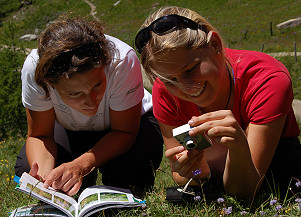
As part of the National Park's educational programmes, excursions related to birds of prey are offered in all three parts of the National Park where rangers and interns inform national park guests about the ‘kings of the air’ on site.
- Details
- Hits: 1989
The golden eagle (Aquila chrysaetos) is considered the emblem of the Alps and is a symbol of the freedom, unspoilt nature and integrity of habitats/regions. The Hohe Tauern also represent an important core habitat for golden eagles within the Austrian Alps. 42–43 pairs breed here. This means that around 15 percent of Austria's total number of golden eagles live here.
From 2003 to 2005, the golden eagles in the Hohe Tauern were surveyed as part of the cross-border project Interreg III-A "The Golden Eagle in the Eastern Alps". Since 2011, these surveys by the national park are conducted almost solely by national park personnel (rangers and professional hunters) with the involvement of other people, mostly from the hunting and forestry communities with the aim to identify population trends and to determine reproduction success.
Generally speaking, the golden eagle population figure is currently stable. An average of 15.7 young eagles per year can be assumed, which corresponds to a reproduction success of 0.46. These values correspond with those for the Alps. However, the generally low growth rates among golden eagles in connection with the high youth mortality rate of 65% between the fledging stage and reaching sexual maturity and the thus not to be underestimated loss of young eagles in the first years show that even stable populations can quickly dwindle if any negative factors begin to take hold.
However, the coming years could be interesting, as golden eagles start to breed in late March/April in the region and the question arises whether climate change will have any possible long term effect on this type of wildlife species.
- Details
- Hits: 628
The mountain range of the Hohe Tauern is the main area in Austria, which is regularly visited by young and non-breeding griffon vultures (Gyps fulvus) in summer. The birds, also known as ‘white-headed vultures’, do not breed in the Hohe Tauern National Park. Their breeding areas are in Friuli (Italy) and the north-western Balkan Peninsula.
The monitoring data shows that 100 to 120 griffon vultures spend the summer in the Hohe Tauern every year. The griffon vultures arrive at the start of the alpine pasture season to search for carcasses of dead animals. The high number of domestic and wild animals that where killed by thunderstorms, falls, diseases, avalanches, but also by predators leads to a sufficient food supply for vultures in the Hohe Tauern. Depending on the food situation, the vultures also switch between breeding areas and summering areas. As part of a scientific project, six griffon vultures were fitted with GPS transmitters at the vulture station of Lago di Cornino. The GPS data and the documentation of observations of ringed birds from south-east and south-west Europe shows the high mobility of this impressive vulture species and its wide-ranging network.
In 2013, three cinereous vultures (Aegypius monachus) spent the summer in the Hohe Tauern. Since then, a very small number of cinereous vultures have repeatedly been observed in the protected area every summer. Data from tagged and ringed birds shows that the rare guests often fly into the Hohe Tauern in the company of griffon vultures from south-east Europe, but also from western Europe.
- Details
- Hits: 378
False suspicions, lies and horror stories led to the extinction of the bearded vulture at the beginning of the 20th century. The first releases in the Kruml valley in 1986 marked the beginning of the reintroduction of the bearded vulture (Gypaetus barbatus) to the Alps. Thanks to cooperation between breeding networks (zoos and breeding stations), wildlife conservation organizations and protected areas, a total of 251 young vultures have been released throughout the Alps (2023). Since the first successful breeding in the wild in 1997 (France), a total 521 wild-hatched young birds have been produced in the Alpine region.
The Alpine-wide population is currently estimated at around 350 bearded vultures.
Despite the well-established population in the Central Alps, the population in the Eastern Alps and the Southwestern Alps is only growing slowly. In Austria, twelve breeding pairs have established themselves to date, six of them live in the Hohe Tauern and a further six pairs in the Ötztal Alps and Lechtal Alps (2024).
According to the results of annual nest monitoring program, a total of 37 breeding successes have been recorded in Austria between 2010 and 2024. The data shows that the number of breeding successes is now slowly increasing, due to the growing number of sexually mature breeding pairs. Strengthening the eastern Alpine metapopulation as an important ‘stepping stone’ to south-east Europe is one of the most important project objectives.
Despite a growing population, the bearded vulture is still threatened by numerous endangerment factors. Lead poisoning is by far the greatest threat. A transnational solution by banning lead-containing ammunition is a top priority in the Alps-wide project. In addition to poisoning, collisions with wind turbines and low-hanging steel cables also pose a major threat, which must be eliminated in further projects.
The consolidation of the Eastern Alpine population and the associated measures are therefore the overarching goal in order to establish a bearded vulture population in the Alps and Europe that can survive without human help.